
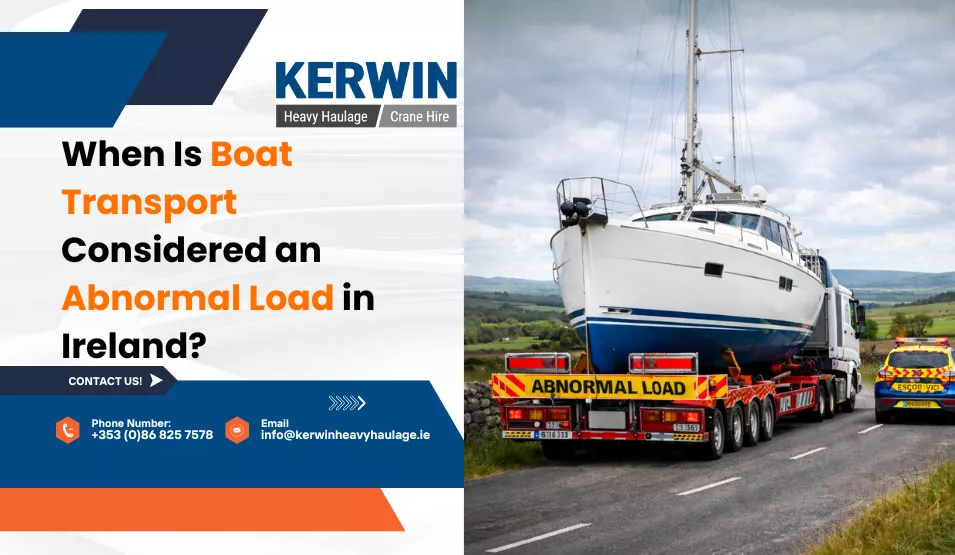
Boat transport in Ireland is considered an abnormal load when the vessel’s dimensions or weight exceed limits defined under Irish vehicle regulations. This classification affects permits, escort vehicles, routing, and safety obligations. Understanding when a vehicle exceeds legal thresholds is essential for compliance, cost control, and risk reduction.
Abnormal Load Regulations in Ireland
In Ireland, abnormal loads are governed by the Road Traffic (Construction, Equipment and Use of Vehicles) Regulations, often referred to in industry discussions as road traffic construction and use rules. These regulations define the lawful weights and dimensions of any vehicle load operating on public roads.
An abnormal load is not simply “large”; it is a load that cannot be divided without unreasonable expense or risk of damage, and where:
- The overall width exceeds 2.55m
- The total length exceeds the prescribed vehicle limits
- The length of the vehicle plus load breaches legal allowances
- The weight of any axle exceeds the permitted axle loads
- The gross vehicle weight exceeds statutory thresholds
What Is Classified as an Abnormal Load in Ireland?
Under Irish regulations, a load becomes abnormal when the vehicle or its load breaches defined dimensional or weight limits.
Key Dimensional Triggers
1. Overall Width
- Standard legal maximum: 2.55m
- If the overall width exceeds 2.55m, the load is considered abnormal
2. Total Length
- Includes tractor unit + trailer + load
- Exceeding prescribed limits triggers abnormal classification
3. Height
Although not always defining abnormal status alone, height becomes critical when:
- Clearance risks arise
- Bridge restrictions apply
- Combined trailer + boat height becomes unsafe
Weight-Related Triggers
A load may be abnormal where:
- Gross vehicle weight exceeds limits
- The weight of any axle exceeds legal axle loads
- An axle exceeds its permissible threshold
- Load distribution causes an axle exceeds condition
Axle weight compliance is crucial because:
- Roads and bridges are engineered for specific loads
- Overloaded axles increase road damage risk
- Enforcement checks focus heavily on axle compliance
Indivisible Load Principle
Many boats qualify as abnormal loads because they are:
- Structurally indivisible
- Impossible to dismantle for standard transport
- Vulnerable to damage if altered
Examples:
- Sailing yachts
- Cabin cruisers
- Commercial fishing vessels
- Wide-beam leisure craft
When Does Boat Transport Become an Abnormal Load?
Boat transport becomes abnormal when regulatory thresholds are exceeded. Below are the most common triggers.
1. Width Beyond the 2.9m Permit Threshold
While the standard legal width for a trailer is 2.55m, Irish regulations generally require a formal Abnormal Load Permit once the total width exceeds 2.9m.
- 55m to 2.9m: The load is “over-width” and requires specific markers/lighting but may not require a full permit on all routes.
- Over 2.9m: Full abnormal load status is triggered, requiring a permit from An Garda Síochána or Local Authorities.
2. Height Exceeding the 4.65m Limit
Transport height is calculated from the road surface to the highest point of the vessel (including the trailer bed and cradle).
- In Ireland, the maximum legal height is 4.65m.
- Exceeding this height makes the load abnormal and necessitates mandatory route surveying to avoid collisions with bridges, toll gantries, and overhead utility lines.
3. Total Length and Rear Overhang
A long hull can cause a vehicle combination to exceed the standard 18.75m length limit for a truck and trailer.
- Rear Overhang: If the boat extends more than 1 metre beyond the rear of the trailer, it must be marked.
- If the overhang is significant (generally over 3m) or the total vehicle length is exceeded, it is classified as an abnormal load, requiring specific route planning for turning circle safety.
4. Axle Weight and Gross Vehicle Weight (GVW)
Even if the boat “looks” manageable, weight distribution is a legal trigger.
- Axle Limits: If a heavy hull causes any single axle to exceed its plated limit (commonly 10 tonnes), the load is illegal under standard conditions.
- Gross Weight: Combinations exceeding 44–46 tonnes (depending on the number of axles) automatically move into the abnormal load category, requiring heavy haulage authorization.
5. Classification as an “Indivisible Load”
Under Irish law, abnormal permits are strictly reserved for loads that cannot be broken down into smaller components without undue expense or risk of damage.
- Because a boat’s hull is a single, solid structure that cannot be dismantled, it qualifies as an Indivisible Load. This allows you to apply for the permits mentioned above rather than being forced to reduce the load size.
When Does Boat Transport Require Heavy Haulage?
Not every abnormal boat move requires heavy haulage. However, certain conditions demand specialist equipment.
1. Extreme Vessel Width
When beam dimensions significantly exceed 2.55m, conventional trailers become unsuitable. Heavy haulage trailers provide stability, correct load distribution, and compliance with Irish weights and dimensions rules.
2. High Gross Vehicle Weight
Larger yachts and commercial boats increase the combined transport mass. Heavy haulage vehicles are engineered to handle loads where the vehicle load approaches regulatory limits or risks that an axle exceeds the scenario.
3. Specialised Trailer Requirements
Standard boat trailers may not support unusual hull shapes or excessive length. Heavy haulage configurations allow custom cradles, extendable beds, and axle group adjustments.
4. Stability & Centre of Gravity Risks
Tall vessels or uneven weight distribution increase rollover risk. Heavy haulage units provide enhanced suspension systems and multi-axle support to control dynamic movement forces.
5. Infrastructure Constraint Challenges
Narrow roads, weak bridges, and tight junctions require vehicles capable of controlled manoeuvring. Heavy haulage solutions often integrate steering axles and advanced braking systems.
Route Planning Challenges for Oversized Boat Transport
Transporting an oversized boat in Ireland is rarely a simple “A to B” operation. Abnormal loads introduce complex routing considerations.
1. Bridge Height Restrictions
Ireland’s road network includes numerous bridges with varying clearance limits. A loaded vehicle carrying a high-profile vessel may:
- Encounter height barriers
- Require diversion planning
- Need structural clearance verification
Ignoring bridge constraints can lead to:
- Severe vehicle damage
- Traffic disruption
- Legal consequences
2. Narrow Rural Roads
Many marinas and boatyards are located along secondary or rural routes where:
- Carriageways are narrow
- Passing space is limited
- Sharp bends restrict movement
Oversized loads may struggle with:
- Encroachment into opposing lanes
- Verge instability
- Restricted turning geometry
3. Urban Access Limitations
Urban areas introduce challenges such as:
- Tight roundabouts
- Parked vehicles
- Overhead cables
- Pedestrian safety zones
Oversized boat transport through towns often requires:
- Escort vehicle coordination
- Temporary traffic management
- Movement timing strategies
Weight-Restricted Structures
Certain bridges and roads impose weight limits. A heavy vessel may cause:
- Gross vehicle restrictions
- The weight of any axle is to exceed the limits
- Enforcement risks
Professional assessment ensures no axle exceeds statutory tolerances.
Do You Need Escort Vehicles for Oversized Boat Transport?
Escort vehicles are required when a transported boat causes the vehicle load to create a safety risk for other road users. In Ireland, escort obligations typically arise when abnormal loads exceed specific width or length thresholds.
When Escorts Become Necessary
Escort vehicles are commonly required where:
- The overall width exceeds 2.55
- The total length of the vehicle and load creates manoeuvring hazards
- The load obstructs standard lane usage
- Visibility for other drivers is compromised
- Junction navigation becomes complex
Permit & Notification Requirements
Abnormal boat transport often requires permits and formal notifications to ensure regulatory compliance.
1. Abnormal Load Permit Requirements
When a vessel causes the vehicle to exceed statutory weights and dimensions, an abnormal load permit may be mandatory. Permits regulate how, when, and where abnormal loads may travel within Ireland.
2. Local Authority Notifications
The relevant local authority must often be notified before movement. This allows assessment of road suitability, bridge limitations, traffic management needs, and infrastructure protection concerns.
3. Garda Síochána Notification
Where load dimensions significantly affect road safety, Garda Síochána may require advance notification. This applies particularly to movements involving extreme width, length, or where traffic disruption risks exist.
4. Lead Time Considerations
Permit approvals and authority coordination require planning. Short-notice abnormal loads frequently face delays, as authorities need time to evaluate routing, safety impact, and structural constraints.
5. Documentation & Load Details
Permit applications typically require:
- Load dimensions
- Gross weight
- Weight of any axle
- Vehicle configuration
- Proposed route
Accurate data prevents rejection or compliance issues.
How Much Does Abnormal Boat Transport Cost in Ireland?
Costs vary depending on several operational factors.
Distance & Route Complexity
Longer transport distances increase fuel usage, driver hours, tolls, and scheduling demands. Routes requiring surveys, diversions, traffic management, or restricted access planning significantly add operational time and cost.
Load Dimensions
Greater overall width, height, or total length typically triggers escort vehicles, specialist trailers, permit requirements, and slower travel speeds, all of which increase labour, equipment utilisation, and compliance expenses.
Permit & Notification Fees
Movements involving abnormal loads may require an abnormal load permit, local authority notifications, and Garda Síochána coordination. Administrative processing, documentation preparation, and lead times contribute to overall project costs.
Escort Vehicle Deployment
Escort vehicles require trained personnel, dedicated vehicles, warning equipment, and communication systems. Multiple escorts for wider loads increase staffing, fuel consumption, journey coordination complexity, and total transport expenditure.
Lifting & Handling Operations
Crane hire, boatyard handling, sling equipment, and lift planning affect pricing. Heavier vessels, difficult access conditions, or extended lift radius requirements substantially increase lifting time, equipment selection, and safety management costs.
Why Specialist Consultation Matters for Safe Boat Transport
1. Regulatory Compliance
Specialists understand Irish vehicle regulations, abnormal loads classification, and permit obligations, reducing legal exposure.
2. Axle Load Management
Expertise ensures the weight of any axle remains compliant, preventing scenarios where an axle exceeds limits.
3. Route Risk Assessment
Professional surveys identify bridge, width, and turning constraints before movement.
4. Safety & Stability Control
Correct trailer selection and securing practices reduce dynamic transport risks.
5. Coordinated Logistics Execution
Permits, escorts, lifting, and scheduling are aligned for safe operations.
For safe, compliant abnormal boat transport in Ireland, consult Kerwin Heavy Haulage. Contact us to discuss your transport requirements.
Conclusion
Boat transport becomes an abnormal load in Ireland when legal weights and dimensions thresholds are exceeded. This classification affects permits, escorts, routing, lifting, and compliance duties. Understanding these requirements protects vessel integrity, ensures public safety, and prevents costly legal or operational consequences.
FAQs
Q. Is every large boat automatically an abnormal load?
Classification depends on whether the vehicle exceeds width, length, height, or axle weight limits.
Q. What happens if an axle exceeds permitted weight?
The vehicle may be prohibited from movement and subject to enforcement penalties.
Q. Can abnormal boat transport occur during daytime?
Yes, but restrictions may apply depending on route, traffic conditions, and permit terms.
Q. Are escort vehicles legally mandatory?
Where thresholds are exceeded or permit conditions specify, escorts are compulsory.
Q. Does abnormal load status affect insurance?
Non-compliance can invalidate cover or trigger liability disputes.