
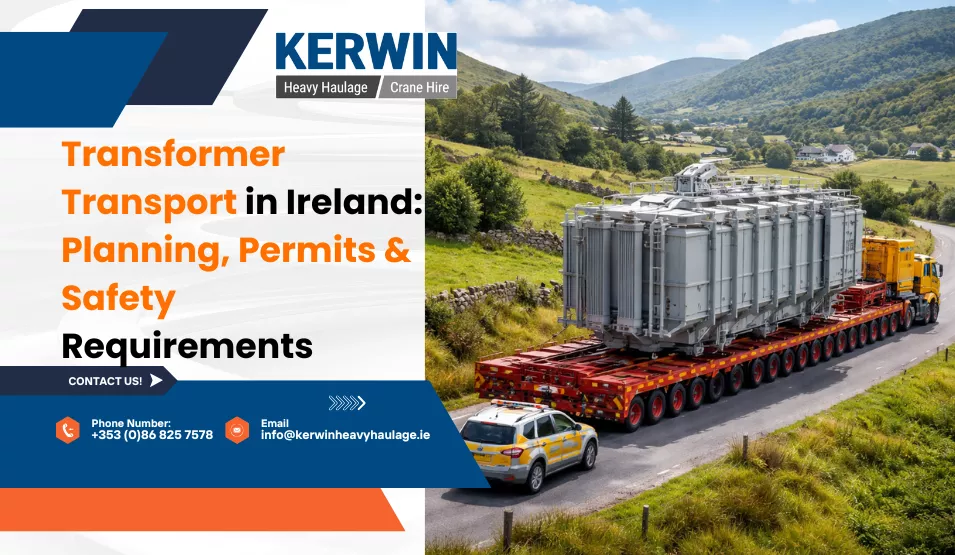
Transformer transport in Ireland is classified as abnormal load transport under national road traffic regulations. It requires formal permit applications, route assessments, Garda notification, bridge capacity checks, and strict compliance with load securing standards.
If you are moving a power transformer anywhere in Ireland, regulatory planning comes first.
Nature of Power Transformers as Abnormal Loads
Under the Road Traffic (Construction and Use of Vehicles) Regulations, most power transformers exceed standard weight and dimension thresholds. Typical units range from 20 tonnes to over 120 tonnes, with concentrated axle loads and high centres of gravity.
Because of their width, height, and gross vehicle weight, they fall under abnormal load classification in Ireland. This triggers specific requirements for permit approval, route planning, bridge assessment and escort coordination. Oil-filled transformers also require spill risk considerations under environmental protection guidance.
Regulatory Framework Governing Transformer Transport in Ireland
1. Road Traffic (Construction & Use) Regulations
These regulations define maximum axle weights, gross vehicle weights and dimensional limits. Any transformer exceeding these thresholds legally becomes an abnormal load requiring formal authorisation before movement.
2. Road Traffic Act Compliance
The Road Traffic Acts govern public road usage and empower authorities to restrict or condition abnormal load movements. Non-compliance can result in prohibition notices and significant penalties.
3. Transport Infrastructure Ireland (TII) Oversight
TII oversees the national road network, including bridge capacity assessments. Movements affecting national routes require structural review and may require engineering approval before permits are granted.
4. Local Authority Notification Requirements
Each local authority must be notified where a load travels through its jurisdiction. They assess road suitability, traffic impact, and infrastructure risks before granting approval.
5. An Garda Síochána Involvement
Garda notification is mandatory for certain abnormal loads. Escort requirements and movement times are often determined in consultation with Garda authorities to ensure public safety.
Abnormal Load Permits in Ireland – Application Process & Timelines
Permit applications must be submitted to the relevant local authorities detailing axle weights, dimensions, route mapping, and movement schedule. Supporting documentation often includes engineering calculations and bridge loading analysis.
Timelines vary by authority but typically require several working days, sometimes longer for complex movements. Cross-county transport may require multiple approvals. Moving without permit approval is unlawful and risks vehicle impoundment and prosecution.
Route Planning & Structural Assessment in the Irish Road Network
Route planning in Ireland is engineering-led. Bridge structures, culverts, roundabouts and road geometry must be assessed against axle load distribution.
TII bridge assessment protocols are applied to national roads. On regional and local roads, local authority engineers review suitability. Height clearance checks for overhead lines and urban restrictions are critical, particularly in rural counties where infrastructure may be limited.
Escort Vehicle Requirements & Traffic Management Obligations
Escort vehicles are required depending on load dimensions and risk profile. Private escort drivers must be trained and certified.
Where necessary, Garda escorts may be mandated. A traffic management plan may be required in urban or high-traffic areas. Temporary road closures and restricted movement hours are common conditions imposed during abnormal load operations.
Vehicle & Trailer Configuration for Transformer Haulage
Transformer haulage typically involves multi-axle hydraulic modular trailers, girder bridge trailers, or low loaders designed for high-capacity transport.
Axle spacing and steering functionality are engineered to reduce ground pressure and comply with Irish axle load regulations. Configuration is determined through weight distribution analysis to prevent bridge overstress and roadway damage.
Loading, Securing & Load Stability Standards
Load securing must comply with EN 12195 standards and best practice engineering calculations. Transformers require bespoke saddles and bracing systems.
Lashing calculations must account for forward, lateral, and vertical forces. Tilt monitoring is often used due to oil surge risks. Incorrect securing can cause structural damage or catastrophic instability during transit.
Crane Coordination & On-Site Lifting Considerations
Lifting transformers requires a formal lift plan prepared by a competent Appointed Person. Ground bearing pressure calculations are mandatory to ensure crane stability.
Tandem lifts may be required for heavier units. Exclusion zones and safety supervision are legally required under Irish health and safety legislation. Coordination between transport and lifting teams must be pre-planned in method statements.
Risk Assessment & Safety Management in Transformer Transport
Comprehensive risk assessments must be completed before movement. This includes route hazards, infrastructure risks, weather exposure and emergency contingency planning.
RAMS (Risk Assessment Method Statements) are standard practice in infrastructure projects. Environmental spill procedures must be prepared for oil-filled units. Safety documentation may be requested by clients and authorities.
Insurance, Liability & Contractual Framework
Transport operations typically operate under IRHA conditions domestically and CMR Convention rules for international transport.
Insurance must cover abnormal load carriage, third-party liability and potential infrastructure damage. Contractual clarity is essential to define responsibility between the supplier, transporter, crane provider and site contractor.
Common Challenges in Transformer Transport Projects
Bridge Capacity Limitations
Older regional bridges may not support concentrated axle loads without engineering assessment or alternative routing.
Narrow Rural Road Infrastructure
Many rural routes present tight geometry challenges requiring specialist steering trailers.
Overhead Line Clearance Restrictions
Height limitations frequently require advance coordination with ESB Networks.
Urban Traffic Congestion
City movements may require night-time scheduling and detailed traffic management planning.
Permit Approval Delays
Multi-authority approval processes can affect programme timelines if not planned early.
Planning Timeline for Transformer Transport Projects in Ireland
Planning typically begins weeks before movement. The sequence includes technical review, route survey, bridge analysis, permit submission, authority approval, escort coordination and final method statement sign-off.
Delays most commonly occur at the permit and structural approval stage. Early engineering engagement significantly reduces the risk of project disruption.
Technical Documentation Required Before Movement
- General arrangement drawings
- Transformer weight specification sheet
- Axle load calculation report
- Route survey documentation
- Bridge structural assessment (if required)
- Permit approvals from relevant authorities
- Garda notification confirmation
- Traffic management plan
- Lift plan and method statement
- Insurance certification
Selecting a Heavy Haulage Partner for Transformer Transport
Engineering Capability
The operator must demonstrate technical understanding of axle loading and bridge assessment.
Permit Management Experience
Proven ability to coordinate with multiple Irish authorities is critical.
Fleet Suitability
Access to modular trailers and steering axle systems is essential for abnormal loads.
Escort Coordination Capacity
In-house escort capability ensures operational control.
Regulatory Compliance Record
Operators should show consistent adherence to Irish transport regulations.
Planning a Transformer Transport Across Ireland and UK?
Kerwin Heavy Haulage brings years of experience managing transformer transport, abnormal load permits and escort coordination across Ireland and into the UK. For complex infrastructure logistics, get in touch.
Conclusion
Transformer transport in Ireland is not routine haulage. It is a regulated engineering operation requiring structured planning, statutory compliance, and coordinated execution.
From abnormal load permits and route assessments to escort vehicles and lift planning, each stage must align with Irish transport law and infrastructure constraints. Early preparation ensures safety, compliance and project continuity.
FAQs
How long does an abnormal load permit take in Ireland?
Typically, several working days, longer for multi-county or complex bridge assessments.
Are Garda escorts always required?
Not always. It depends on load size, route and authority assessment.
Can transformers travel during daytime hours?
Movement times are often restricted, particularly in urban areas.
Do all bridges require structural checks?
Not all, but heavy axle loads often trigger engineering review.
Is insurance different for abnormal loads?
Yes, specialised cover for abnormal load transport is usually required.