
Choosing the right crane for a construction project in Ireland is not always straightforward. Loads differ, sites vary, and safety rules are strict. This guide explains exactly how crane selection works, what affects the decision, and how Irish lifting operations are typically planned so you can understand the process clearly from the start.
Why Crane Selection Matters in Irish Construction?
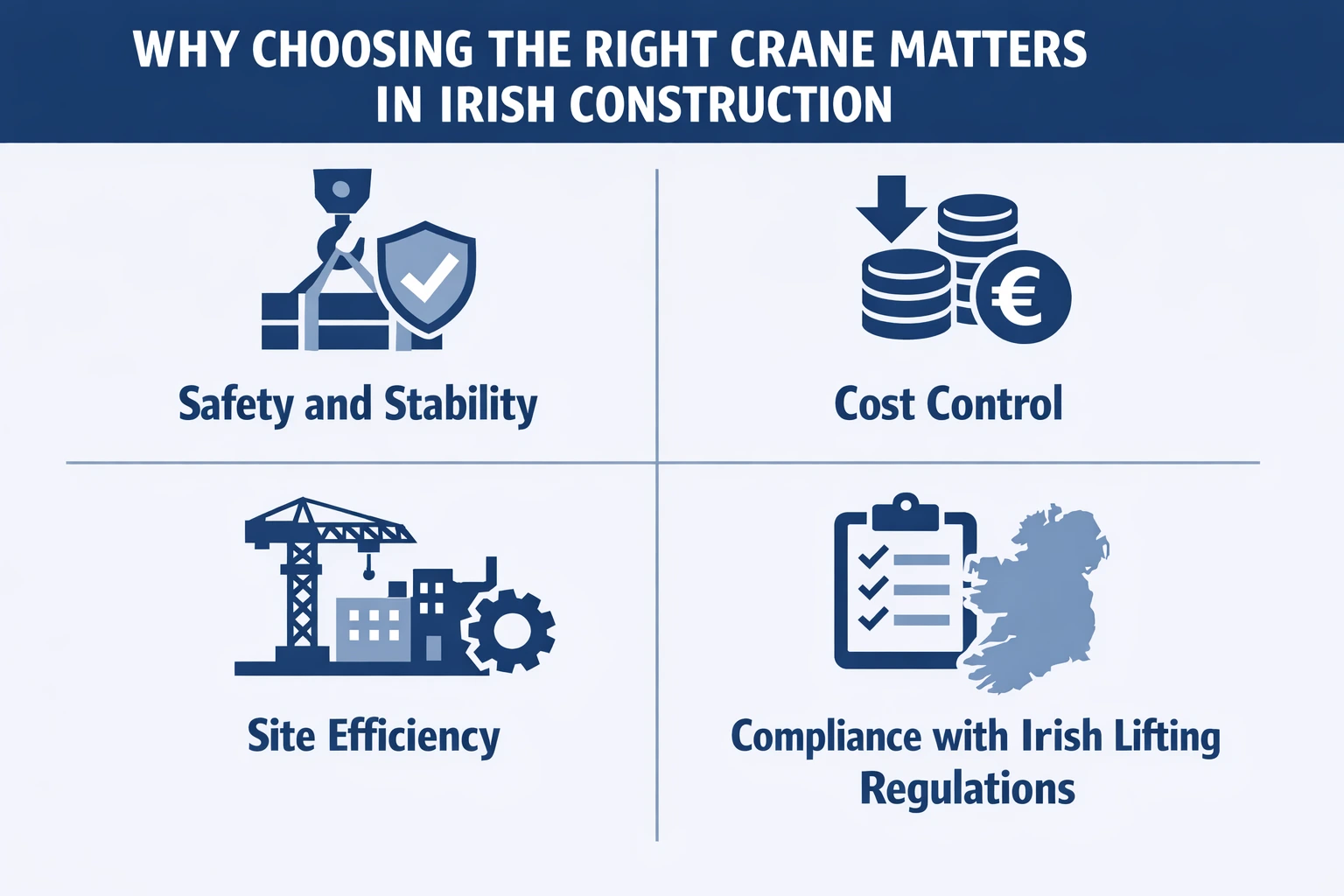
Selecting the correct crane is one of the most important decisions in any construction project. A wrong choice can cause delays, increase costs, and create safety risks. In Ireland, where many projects take place in tight rural lanes, busy urban streets, or weather-sensitive conditions, thoughtful crane selection becomes even more crucial.
The purpose of choosing the right machine, whether a city crane, mobile crane, or truck-mounted crane, is to ensure the lift is carried out safely, efficiently, and without disruption to the wider site. The right crane leads to:
- Faster project completion
- Reduced operational costs
- Enhanced safety and stability
- Better control over load positioning
- Compliance with Irish lifting regulations
Without correct crane selection, even a simple lift can become complicated. That is why understanding the fundamentals is essential before any lifting operation begins.
Crane Types Used in Ireland
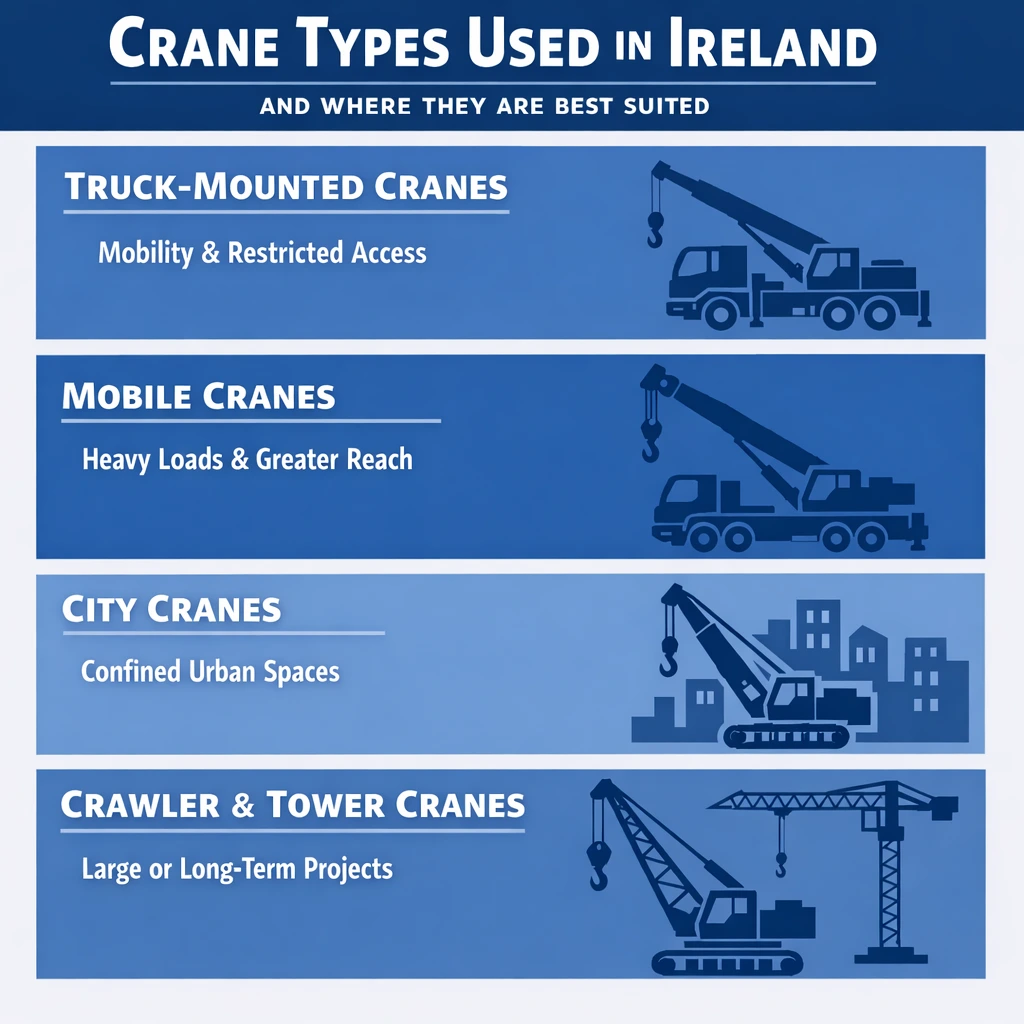
Ireland uses a wide range of cranes depending on the site conditions, load types, lifting height, and mobility required. The most common types encountered in everyday construction include:
1. Truck-Mounted Cranes
These cranes are installed on a heavy truck chassis, allowing them to travel easily between sites. Their key advantages include:
- Rapid mobilisation
- Flexibility for urban and rural sites
- Ability to lift and transport loads in one movement
- Excellent performance in restricted-access areas
Truck-mounted cranes are widely used across Ireland for steel lifts, container handling, machinery placement, and transport-related lifting solutions.
2. Mobile Cranes
Mobile cranes offer high lifting capacities and long reach. They are ideal for larger construction projects where heavy or tall loads need to be lifted safely. Benefits include:
- Strong lifting capacity
- Adjustable boom lengths for different heights
- Quick set-up
- Versatility for multiple industries
Mobile crane hire is often chosen for structural work, roof truss installation, plant movement, and heavy industrial projects.
3. City Cranes
Designed for tight spaces, city cranes are compact machines used in confined urban environments where streets are narrow and space is limited.
4. Crawler Cranes & Tower Cranes
These are used for highly specialised projects, such as large construction sites, civil engineering works, or long-term builds. They require more planning and extended setup times.
Each crane type serves a specific purpose. The key is understanding which machine aligns with the project’s requirements.
Key Factors to Consider Before Choosing a Crane
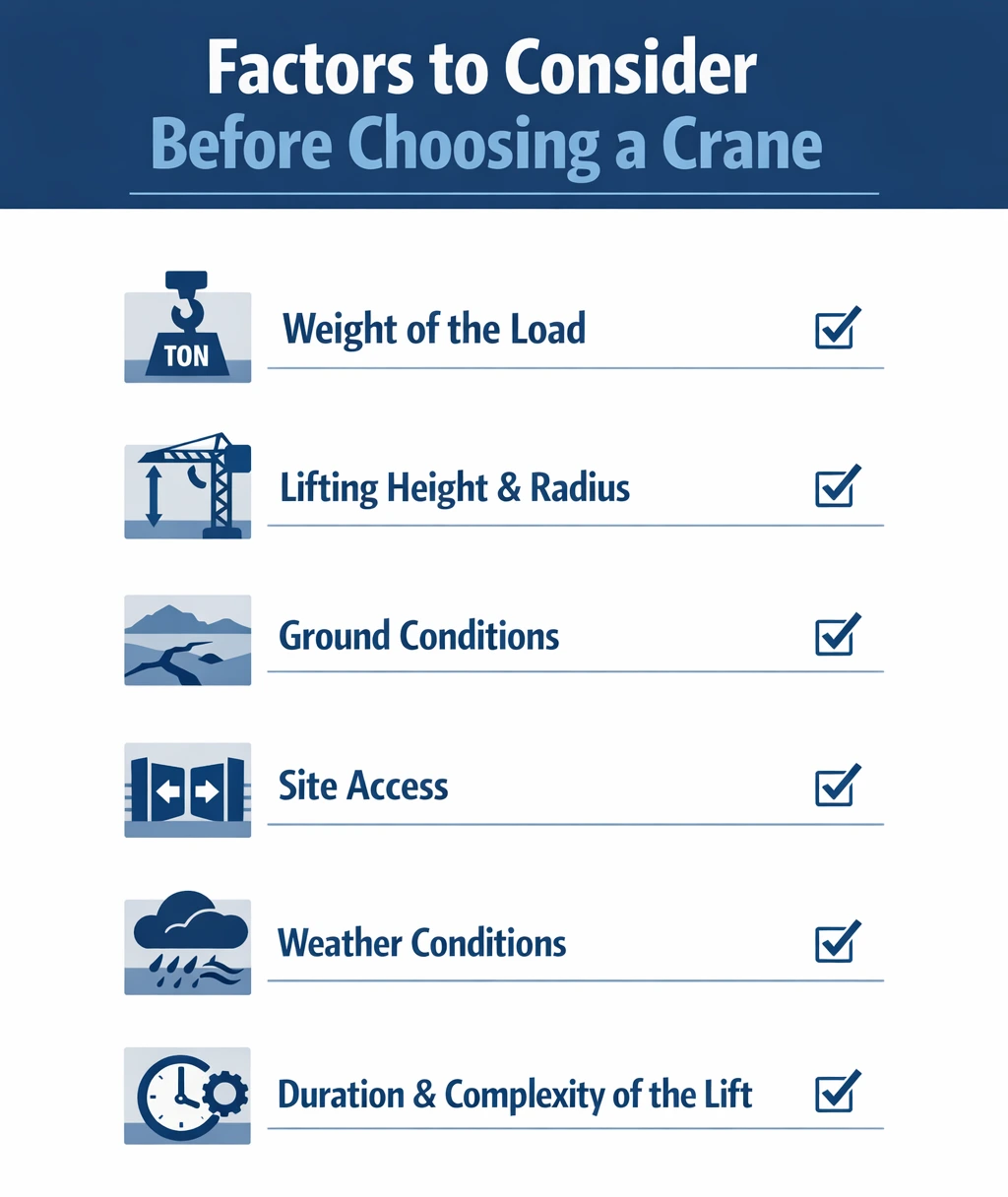
Selecting a crane is not simply about choosing the biggest or strongest machine. Several technical factors influence the correct choice:
1. Weight of the Load
Every crane has a maximum lifting capacity. Exceeding this is dangerous and illegal. To determine the right crane:
- Know the exact weight of the load
- Consider any attachments, lifting gear, or additional components
- Allow a safety margin as required by lifting standards
2. Lifting Height and Radius
The “radius” is the distance between the crane and the load. As the radius increases, the crane’s capacity decreases. This is one of the most misunderstood concepts for newcomers. The crane must be chosen based on:
- Vertical height
- Horizontal radius
- Angle of the boom
3. Ground Conditions
Ireland’s climate creates challenges such as soft ground, wet soil, and uneven surfaces. Cranes require a stable footing, so ground conditions affect:
- Whether outrigger mats are needed
- If additional support is required
- Whether certain cranes are unsuitable for the terrain
4. Access to the Site
Urban construction, small laneways, agricultural yards, and industrial units all present access constraints. Consider:
- Road width
- Overhead wires
- Turning radius
- On-site obstacles
5. Duration and Complexity of the Lift
A simple lift may only require basic equipment, but long or complex lifts, such as multiple placements or repetitive sequences, require more thorough planning.
6. Weather Conditions
Wind affects crane stability, especially for tall lifts. Rain and cold can impact setup, ground stability, and load handling. Ireland’s climate must always be considered when choosing lifting equipment.
Understanding Lift Planning in Ireland
A lift plan is a legally required document that outlines how a lift will be executed. It is essential for safety and compliance. A typical Irish lift plan includes:
- A detailed risk assessment
- Crane configuration
- Load details and lifting points
- Slinging and rigging requirements
- Ground analysis
- Operator instructions
Simple, Standard, and Complex Lifts
- Simple Lifts: Straightforward loads with minimal risk
- Standard Lifts: Require planning but remain predictable
- Complex Lifts: Involve heavy loads, unusual shapes, limited access, or environmental risks
Understanding which category your lift falls into ensures the right crane is selected.
Irish Safety Regulations You Must Follow
Ireland has strict lifting regulations to protect workers and the public. Key requirements include:
LOLER (Lifting Operations and Lifting Equipment Regulations)
Ensures lifting equipment is examined regularly and used safely.
PUWER (Provision and Use of Work Equipment Regulations)
Ensures equipment is suitable and maintained.
HSA (Health and Safety Authority) Standards
Require proper planning, competent personnel, and safe execution of all lifting operations.
Permits for Public Roads
For city crane operations or roadside lifts, additional permissions may be required from local councils or An Garda Síochána.
Understanding these rules helps ensure that every lift is executed within legal and safety guidelines.
How Site Surveys Help You Choose the Right Crane
A site survey provides essential information before any lift. During a survey, experts check:
- Access routes
- Ground stability
- Load positioning areas
- Obstructions
- Space for outriggers and setup
- Overhead hazards
Without a survey, the risk of delays or selecting the wrong crane increases.
Common Scenarios & Which Crane Works Best
1. Residential Construction
- Roof trusses
- Timber frames
- Hot tubs
Best option: Truck-mounted or city crane
2. Commercial Construction
- Structural steel
- Cladding
- HVAC units
Best option: Mobile crane
3. Industrial Projects
- Machinery movement
- Plant installation
Best option: Mobile crane or heavy hiab
4. Agricultural or Rural Sites
- Limited access
- Soft ground
Best option: Truck-mounted crane with mobility and quick setup
Cost Factors When Hiring a Crane in Ireland
Crane hire costs vary depending on:
- Type of crane
- Lifting capacity
- Number of personnel required
- Duration of hire
- Distance travelled
- Level of planning needed
- Need for extra equipment, such as mats or rigging
Hidden costs are avoided when the correct crane is chosen from the start.
Differences Between Mobile Cranes and Truck-Mounted Cranes
Truck-Mounted Cranes
- Better mobility on public roads
- Fast setup
- Ideal for lower to mid-range lifts
- Excellent for restricted access
Mobile Cranes
- Higher lifting capacity
- Greater reach
- Suitable for complex construction lifting
Each has advantages; choosing depends on load, height, radius, and site constraints.
How to Choose the Right Partner
- A suitable lifting partner should have:
- Knowledge of Irish construction environments
- Experience with different crane types
- Strong safety culture
- Accurate lift planning
- Skilled operators and riggers
- Reliable equipment suited to your project
Get Professional Help: Kerwin Heavy Haulage
If you need guidance selecting the right crane for your project, Kerwin Heavy Haulage provides specialist Truck-Mounted and Mobile Crane hire solutions across Ireland. Our team can assess your site conditions, review lifting requirements, and recommend the safest and most efficient approach based on years of hands-on experience supporting construction, industrial, and commercial projects.
Conclusion
Choosing the right crane for a construction project is a technical process involving load analysis, site assessment, safety rules, and equipment capability. With the correct knowledge and planning, lifting operations can be carried out safely, efficiently, and in full compliance with Irish regulations. Understanding the fundamentals ensures your project runs smoothly from start to finish.
FAQs
How do I know which crane size I need?
By calculating weight, height, radius, and site conditions.
Do cranes still operate in bad weather?
Lifts stop in unsafe wind speeds or poor visibility.
What is a contract lift?
A lift where all planning, equipment, and personnel are handled by the crane provider.
Is a site survey always required?
It is highly recommended for safety and accuracy.
Can cranes operate on soft ground?
Only if stabilised properly, ground conditions must be assessed.