
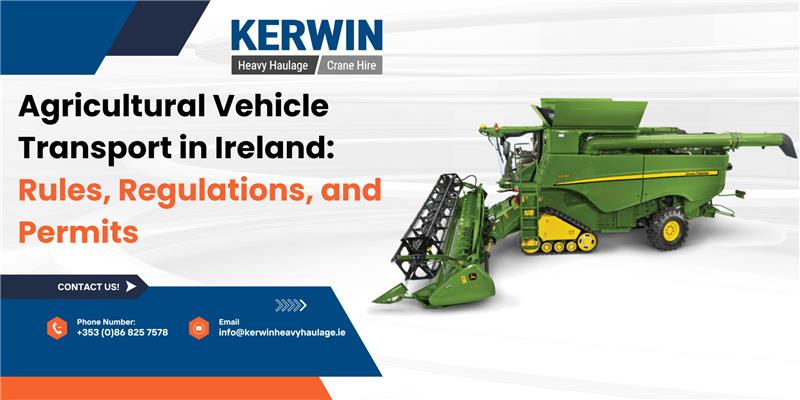
If you’re planning to move agricultural machinery or farm equipment across Ireland, it’s essential to understand that strict rules govern the size, weight, and conditions under which these vehicles can be transported.
Whether you’re moving a tractor, combine harvester, or any other heavy farming equipment, agricultural vehicle transport in Ireland is regulated by both national and local authorities.
In many cases, permits are required, especially if the load exceeds standard limits.
This article outlines what qualifies as an abnormal load, when permits are needed, and how to ensure your transport is legal and safe.
What Counts as an Abnormal Load?
In simple terms, an abnormal load is any vehicle or transported item that exceeds the standard legal size or weight limits on Irish roads. These are not arbitrary, but they’re based on safety and infrastructure constraints.
According to Irish regulations:
- Height limit: 4.65 meters
- Width limit: 4.3 meters
- Length limit: 27.4 meters (on designated roads)
- Weight limit: Varies depending on the number of axles and vehicle design
Any agricultural vehicle or machinery exceeding these limits will be considered an abnormal or oversized load, requiring prior approval and permits.
Indivisible Loads: What Does That Mean?
Many agricultural machines, such as silage trailers, harvesters, and grain dryers, are too large to be broken down for transport. These are known as indivisible loads.
An indivisible load is:
- Something that cannot be divided without risk of damage or unreasonable cost
- Often includes large equipment like tankers, industrial sprayers, or irrigation reels
If your load is both abnormal and indivisible, it falls into a stricter transport category and demands special permits and additional safety measures.
Special Case: Baled Agricultural Produce
One key exception applies to transporting agricultural baled produce (e.g., hay, straw, or silage):
- There is no height limit on these loads
- However, weight and load distribution rules still apply
Even without a height cap, you must ensure that:
- Your vehicle doesn’t exceed its gross vehicle weight rating (GVWR)
- Bales are properly secured to prevent shifting or falling
- The load does not cause the vehicle to become unstable
When Do You Need a Permit?
You’ll need to apply for a permit if your vehicle + load exceeds:
| Dimension | Limit | Permit Type |
| Height | Over 4.65 m (non-baled) | Local Authority |
| Width | Over 4.3 m | An Garda Síochána (designated roads) + Local Authority (others) |
| Length | Over 27.4 m | An Garda Síochána or Local Authority |
| Weight | Exceeds legal max | Local Authority |
Reminder: If transporting baled produce, you’re exempt from height limits, but still bound by weight and safety regulations.
Who Issues the Permits?
There are two authorities that issue abnormal load transport permits in Ireland:
1. An Garda Síochána
- Applies to designated national routes
- For loads up to 27.4 m in length and 4.3 m in width
- Applications must include route, load dimensions, timing, and vehicle details
2. Local Authorities
Required for:
- Non-designated roads
- Loads exceeding 4.3 m width or 27.4 m length
- Any weight exceeding the legal limit
Processing time and requirements also vary between local authorities
Step-by-Step: Applying for Permits
Here’s a quick rundown of what to do:
1. Measure your load: Know exact height, width, length, and weight.
2. Identify your route: Check if it includes designated roads or local roads.
3. Choose the right permit authority:
a) An Garda Síochána for standard national routes within limits
b) Local authorities for anything else
4. Submit your application early: Especially during busy farming seasons.
5. Provide supporting documentation: Vehicle type, registration, intended route, and load details.
Kerwin Heavy Haulage has helped coordinate hundreds of abnormal load movements across Ireland. We always endeavor to double-check with every local authority whose roads you plan to use. Each one may have slightly different procedures.
Safety and Legal Compliance
Beyond permits, how you load and secure your agricultural machinery matters just as much.
Must-Dos for Load Safety:
- Distribute weight evenly over axles
- Use heavy-duty chains or straps rated for the equipment
- Secure all parts of the load to prevent movement or tipping
- Attach flags or warning lights where necessary
- Make sure the load doesn’t obstruct lights or license plates
Why It Matters:
- Prevents road accidents
- Avoids hefty fines and vehicle impoundment
- Maintains compliance with insurance requirements
Route Planning for Large Agricultural Equipment
Proper route selection is essential when moving oversized machinery.
Tips:
- Avoid low bridges and weight-restricted roads
- Check for narrow lanes or tight bends in rural areas
- Prefer designated roads where possible (easier permits)
- Travel during off-peak hours for better maneuverability
If your journey crosses multiple counties, you may need permits from each local authority. Always confirm in advance.
Need Help Navigating Your Agricultural Load?
If you’re unsure which permit applies or how to plan a safe transport route, it’s better to work with professionals. At Kerwin Heavy Haulage, we’ve been handling abnormal load permits and agricultural machinery transport in Ireland for years, ensuring our clients move their heavy loads safely, legally, and on time.
Let us take the stress out of your next move, reach out for expert guidance.
Conclusion
Transporting agricultural vehicles and equipment in Ireland isn’t as simple as loading up and hitting the road. There are strict rules around vehicle dimensions, weight limits, and route permissions, all designed to keep roads safe and traffic flowing.
To stay compliant:
- Know your vehicle and load limits
- Determine if your load is abnormal or indivisible
- Apply for the correct An Garda Síochána or local authority permits
- Plan your route and ensure safe load securing
With proper planning and the right paperwork, your agricultural machinery transport can be efficient, safe, and fully compliant, helping your farm or business keep moving without interruption.
Frequently Asked Questions
What is the height limit for agricultural machinery transport in Ireland?
The general height limit is 4.65 m. However, baled agricultural produce (like hay or silage) is exempt from this limit. That said, your vehicle must still not exceed its design weight, and the load must be safely secured.
When is a permit needed for moving agricultural loads?
You’ll need a permit if your load exceeds 4.3 m in width, 4.65 m in height (non-baled), or 27.4 m in length. You’ll also need a permit if the weight is above legal limits. Permits come from An Garda Síochána for designated routes and local authorities for others.
Who should I contact for transport permits?
Contact An Garda Síochána if your journey is along designated roads within basic abnormal load limits. For anything beyond that or for local roads, reach out to the local authority relevant to your route.
Are permit applications complicated?
Not necessarily. With the right documentation and early planning, you can avoid most hurdles. Just be sure to take expert assistance from Kerwin Heavy Haulage.