

Transporting modular buildings across Ireland is a complex logistical operation, not a standard delivery. These structures are large, heavy, and sensitive to movement. From route planning and permits to escort vehicles and crane lifts, every stage must be carefully controlled to ensure safety, compliance, and structural integrity.
What is a Modular Building?
A modular building is a structure that is manufactured in a controlled factory environment and then transported to the site in large sections, often as complete units.
These buildings are commonly used for:
- Schools and classrooms
- Hospitals and healthcare units
- Offices and commercial spaces
- Site cabins and welfare units
- Residential and housing developments
You may also hear them described as:
- Modular units
- Prefabricated buildings
- Volumetric buildings
Although they are built off-site, these units are fully finished structures, often including internal walls, wiring, plumbing, and external cladding. This makes them efficient to install but challenging to move.
The challenge comes from the fact that modular buildings are:
- Large in width, height, and length
- Extremely heavy
- Structurally rigid but still fragile during transport
Once they leave the factory, safe transportation becomes the most critical stage of the entire project.
Why is Transporting Modular Buildings Not a Normal Delivery?
Transporting a modular building is fundamentally different from moving machinery or pallets. These units often exceed standard road transport limits for width, height, length, and weight, placing them firmly outside normal haulage operations.
In Ireland, road infrastructure presents additional challenges. Narrow rural roads, historic villages, tight junctions, low bridges, overhead services, and roundabouts all create potential obstacles. A modular unit may physically fit on a trailer but still be impossible to move safely without advance planning.
Another critical issue is fragility. Although modular buildings are robust once installed, they can be vulnerable during transport. Excess vibration, uneven load distribution, or sudden braking can cause cracking, distortion, or internal damage that may not be immediately visible but can affect long-term performance.
For these reasons, modular buildings are typically transported as abnormal loads, requiring specialist vehicles, trained drivers, escort vehicles, and strict adherence to Irish transport regulations.
Step-by-Step: How Modular Buildings Are Transported in Ireland

1. Route Planning & Permits
Every successful modular building move starts with route planning. This involves detailed road surveys to assess widths, turning radii, gradients, bridge capacities, and overhead clearances. In many cases, multiple routes are reviewed to identify the safest and most practical option.
Because modular buildings often exceed legal limits, permits are required from the relevant authorities. This includes coordination with local councils and, where necessary, Garda permissions. Timing restrictions may apply, limiting movements to specific hours, days, or night-time windows to minimise traffic disruption.
This planning phase is not optional. Without it, a modular building can become stranded mid-route, leading to costly delays, reputational damage, and safety risks.
2. Loading at the Factory
Loading is one of the most critical stages of the entire operation. Modular units are typically lifted using cranes or heavy lifting systems designed to distribute weight evenly across the structure. Spreader beams are often used to prevent stress concentrations and protect the integrity of the building frame.
During loading, modules are carefully aligned on the trailer to ensure correct weight distribution. Protective measures are applied to vulnerable areas such as corners, roof edges, and finished surfaces. Any error at this stage can compromise the entire transport process.
3. Heavy Haulage Transport
Once loaded, the modular building is transported using specialist heavy haulage equipment. This usually includes low-loaders or extendable trailers fitted with air-ride suspension, which reduces vibration and absorbs road irregularities.
Air suspension is especially important for modular buildings, as it helps protect internal finishes and structural connections. Speed management, controlled braking, and smooth acceleration are all essential during transit, particularly when navigating uneven roads or tight urban areas.
The transport phase is continuously monitored, with drivers adjusting their approach based on road conditions, weather, and traffic.
4. Escort Vehicles
Because modular buildings are oversized, escort vehicles are almost always required. These operate at the front and rear of the convoy, warning other road users, managing traffic, and assisting the driver through narrow roads, junctions, and bridges.
Escort drivers play a critical safety role. They communicate constantly with the transport vehicle, identify hazards in advance, and ensure the movement complies with permit conditions. On Irish roads, where space can be limited, escort vehicles are often the difference between a smooth operation and a serious incident.
5. Delivery to Site
Delivery is carefully timed to reduce disruption and risk. Many modular building moves take place early in the morning or during night hours. On arrival, the unit is positioned precisely to allow efficient crane lifting and installation.
The transport team works closely with site management to ensure access routes are clear, ground conditions are suitable, and lifting equipment is ready. Poor coordination at this stage can undo weeks of careful planning.
Are Modular Buildings Classed as Abnormal Loads in Ireland?
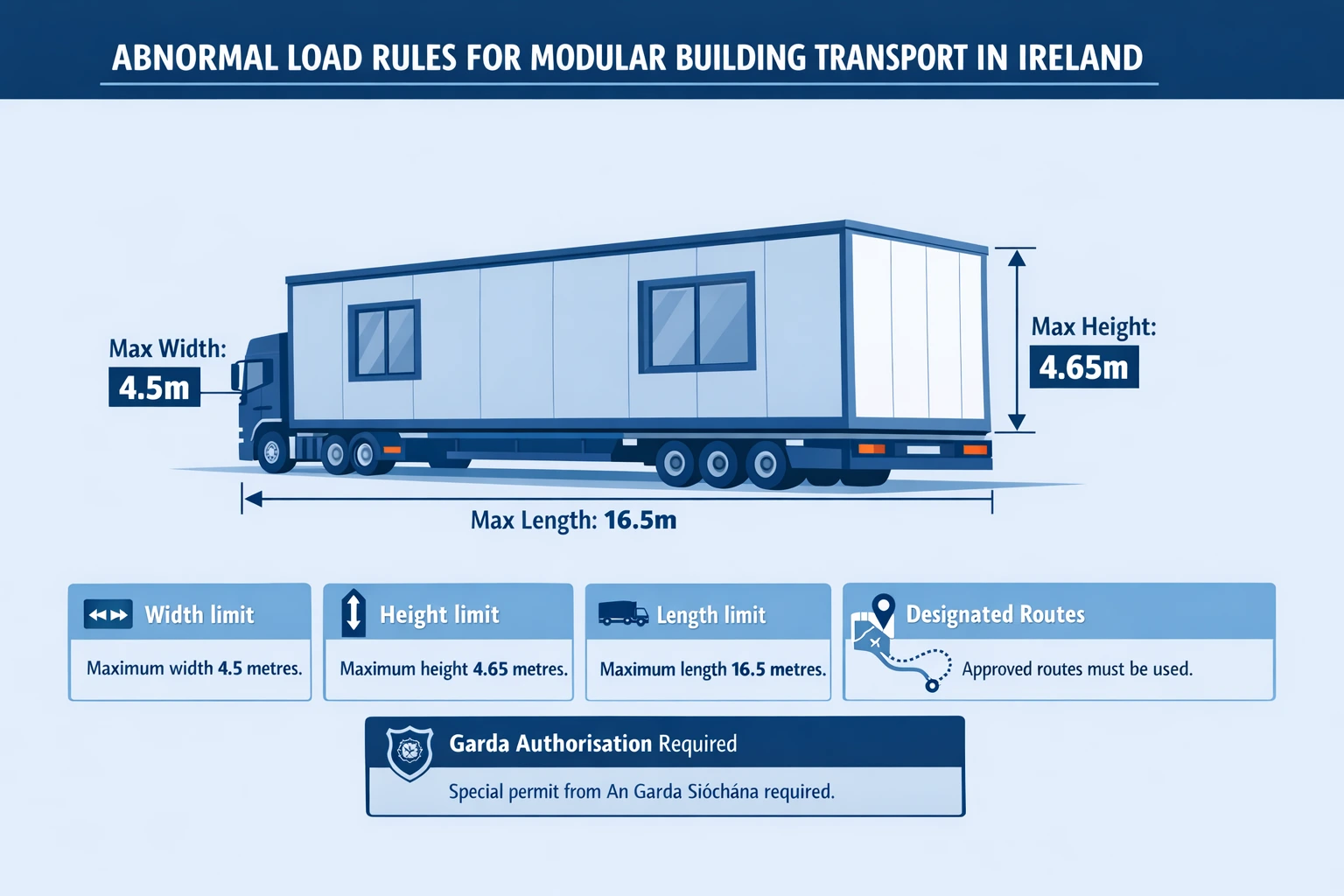
In most cases, yes. Under Irish regulations, loads are classed as abnormal if they exceed specific limits for width, height, length, or weight. Modular buildings frequently exceed one or more of these thresholds.
Even relatively small modular units can qualify as abnormal loads due to their width or height. Larger multi-module buildings almost always require abnormal load classification, permits, and escort vehicles.
According to Garda Movement of Abnormal Loads
- Loads not exceeding 27.4 metres in length and 4.3 metres in width may travel on approved Designated Routes
- These routes typically cover major inter-urban roads and access routes to ports such as Cork, Rosslare, and Ringaskiddy
- Movement outside these routes requires additional authorisation
Crane Hire: How Modular Buildings Are Lifted into Place
Transport is only half the process. Once on site, modular buildings must be lifted into position with precision. Crane selection depends on several factors, including module weight, lifting radius, site access, and ground bearing capacity.
A detailed lift plan is developed to define lifting points, crane positioning, exclusion zones, and communication protocols. Ground conditions are assessed to ensure stability, and safety zones are enforced to protect workers and the public.
Crane operations for modular buildings demand coordination and experience. Even small miscalculations can lead to delays or damage, which is why lifting is always treated as a specialist operation.
Why Modular Building Companies Choose Specialist Hauliers
Modular building transport is not something that can be handled by general haulage providers. The risks are simply too high. Inexperienced operators may lack the equipment, insurance, or regulatory knowledge required for abnormal loads.

Mistakes in planning or execution can lead to damaged buildings, missed deadlines, and financial penalties. Specialist hauliers bring years of experience, state-of-the-art equipment, trained personnel, and proven systems for managing complex moves.
This is why modular building manufacturers and developers consistently choose partners who understand the full logistics chain, from factory loading to final placement.
How to Choose the Right Partner?
When selecting a transport partner for modular buildings, experience and capability matter more than cost. The right partner will understand abnormal loads, route planning, escort vehicles, crane coordination, and regulatory compliance as a single integrated process.
Get Professional Help with Kerwin Heavy Haulage
Kerwin Heavy Haulage has supported modular building transport and abnormal load movements across Ireland, the UK, and mainland Europe for many years. With specialist equipment, experienced operators, and a deep understanding of complex logistics, Kerwin Heavy Haulage provides the professional support required for safe and compliant modular building transport.
Conclusion
Transporting modular buildings safely across Ireland requires far more than moving a large object from point A to point B. It demands careful planning, regulatory compliance, specialist vehicles, escorting, skilled operators, and precise lifting. When handled correctly, modular transport is safe, efficient, and reliable. When handled poorly, the risks are significant. Understanding the process is the first step toward making informed, responsible decisions.
FAQs
Can modular buildings be transported on normal trucks?
In most cases, no. Their size and weight usually require specialist heavy haulage equipment.
Do all modular buildings need escort vehicles?
Most do, especially if they exceed legal width or height limits.
Can modular buildings be transported in bad weather?
Weather conditions are carefully assessed, and movements may be delayed if safety is compromised.
How long does it take to plan a modular building transport?
Planning can take days or weeks, depending on route complexity and permit requirements.
Is transport damage common with modular buildings?
Damage is rare when specialist procedures and equipment are used correctly.